 Become a Patron!
Over the years, I’ve received countless messages from people who want to “pick my brain,” “have a quick chat,” or “grab coffee” to learn about how I became a sexologist. Most start with admiration, praise, and curiosity. On the surface, these messages seem kind and respectful — but what they’re really doing is asking for free access to my time, energy, and expertise.
Recently, I received yet another one of these messages. It followed the familiar structure: praise, curiosity, and then the ask.
“Would love if I can invite you on a coffee chat/or even online if it’s better for you.”
That line might sound harmless to most — but here’s the first red flag:
1. Assuming the answer is already yes
This kind of phrasing doesn’t ask if I’m open to a chat — it assumes I should be. The default expectation is that I’ll say yes, because I was flattered, or because they’re “genuinely curious,” or because “they’re a student.” There’s no acknowledgment that my time might be limited, that I may not offer that kind of access, or that I’ve likely had hundreds of similar requests before. It’s entitlement in polite clothing.
I responded clearly and professionally:
“Thanks for reaching out but I do not give away my time for free as I already do so much for others. You can book a time to see me through consultation link www.eroscoaching.com.
The basic advice here is: many people say they want to do what I do but don’t have the qualifications I have and aren’t willing to spend the time/energy/money to get the training they need. As a result, they will never gain the credibility or abilities to help people the way they desire. So in summary: go get the training.”
I set a boundary. I didn’t insult or belittle anyone. I gave honest feedback and offered a way forward: book a session if you’re serious.
But as so often happens, the response ignored the boundary — and instead tried to reframe me and the situation entirely:
“Totally understand where you’re coming from and how frustrated it must be to see people who want to do what you do but are not willing to spend time/energy/money!”
“I am on my way indeed to finish my master in psychology by the end of this year and also want to know how much of time/energy/money it entails to do such job so that’s why I reach out to you.”
Let’s unpack this, because this kind of reply is exactly why people like me stop being generous with our time.
What’s wrong with these kinds of replies?
2. Reframing my boundary as emotional or negative
I never said I was frustrated. I said I don’t give away my time for free. That’s not emotional — that’s professional. But instead of taking my words at face value, they reframed it as though I’m reacting out of irritation or bitterness. That’s a form of soft blame. It makes me the problem instead of accepting my boundary.
3. Continuing the ask after I’ve already said no
I gave a clear answer. I offered a paid option. And still, the person circled back to justify their ask:
“That’s why I reach out to you.”
This is wrapped in politeness, but it’s still a way of saying, “Please talk to me anyway.” It’s pressure disguised as explanation.
4. Making me seem rude or cold
Sometimes these interactions escalate subtly — implying I’m being harsh, unhelpful, or cold. But here’s the question:
“I do not give away my time for free… You can book a time to see me through www.eroscoaching.com.”
Is that rude? Or is it just uncomfortable for people to hear a firm boundary when they expected automatic access?
Why I say no now — and mean it
Let’s be honest: it’s never just five minutes. It’s never “just coffee.” Every time someone asks for an informal chat, it costs me time, energy, and focus. I’ve been through this loop too many times. I’ve helped people and companies get free advice, connections, and visibility — only for them to vanish without acknowledgment, credit, or goodwill.
I’ve been burned. And I’ve learned.
I’m an introvert. I need time to recharge. I reserve my best energy for paying clients who respect the work and the process. Those are the people I show up fully for.
I don’t give my professional labor away for free anymore. Not because I’m rude. But because I’ve finally learned to stop betraying myself to make others comfortable.
If you really respect someone’s work:
-
Don’t interpret kindness as a guarantee of access
-
Don’t repackage your ask after a boundary is set
-
Don’t make someone else the problem for saying no
-
Do book their time
-
Do respect the boundary the first time
As for me?
Book my time. That’s how you get me to talk about work — during work hours.
No tea. No coffee. No meals. I don’t talk about work outside of work if I can help it.
I’ve worked too hard to build what I have — and I protect my energy in a way it deserves to be protected.
About Dr. Martha Tara Lee

Dr. Martha Tara Lee has been a passionate advocate for positive sexuality since 2007. With a Doctorate in Human Sexuality and a Master’s in Counseling, she founded Eros Coaching in 2009 to help individuals and couples lead self-actualized and pleasurable lives. Her expertise includes working with couples in unconsummated marriages, individuals with sexual inhibitions or desire discrepancies, men facing erection and ejaculation concerns, and members of the LGBTQIA+ and kink communities. She welcomes people of all sexual orientations and offers both online and in-person consultations in English and Mandarin.
Dr. Lee is the only certified sexuality educator by the American Association of Sexuality Educators, Counselors and Therapists (AASECT) in the region since 2011, and became an AASECT-certified sexuality educator supervisor in 2018. Her fun, educational, and sex-positive approach has been featured in international media including Huffington Post, Newsweek, and South China Morning Post. She currently serves as Resident Sexologist for the Singapore Cancer Society, Of Noah.sg, OfZoey.sg, and Sincere Healthcare Group., and is the host of the podcast Eros Matters.
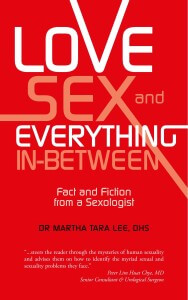
An accomplished author, Dr. Lee has published four books: Love, Sex and Everything In-Between (2013), Orgasmic Yoga: Masturbation, Meditation and Everything In-Between (2015), From Princess to Queen: Heartbreaks, Heartgasms and Everything In-Between (2017), and {Un}Inhihibited (2019). Her contributions have been recognized with numerous honors, including Her World’s Top 50 Inspiring Women under 40 (2010), CozyCot’s Top 100 Inspiring Women (2011), Global Woman of Influence (2024), the Most Supportive Relationship Coach (Singapore Business Awards, APAC Insider, 2025), and the Icon of Change International Award (2025).
You can read the testimonials she’s received over years here. For her full profile, click here. Email her here.