 Become a Patron!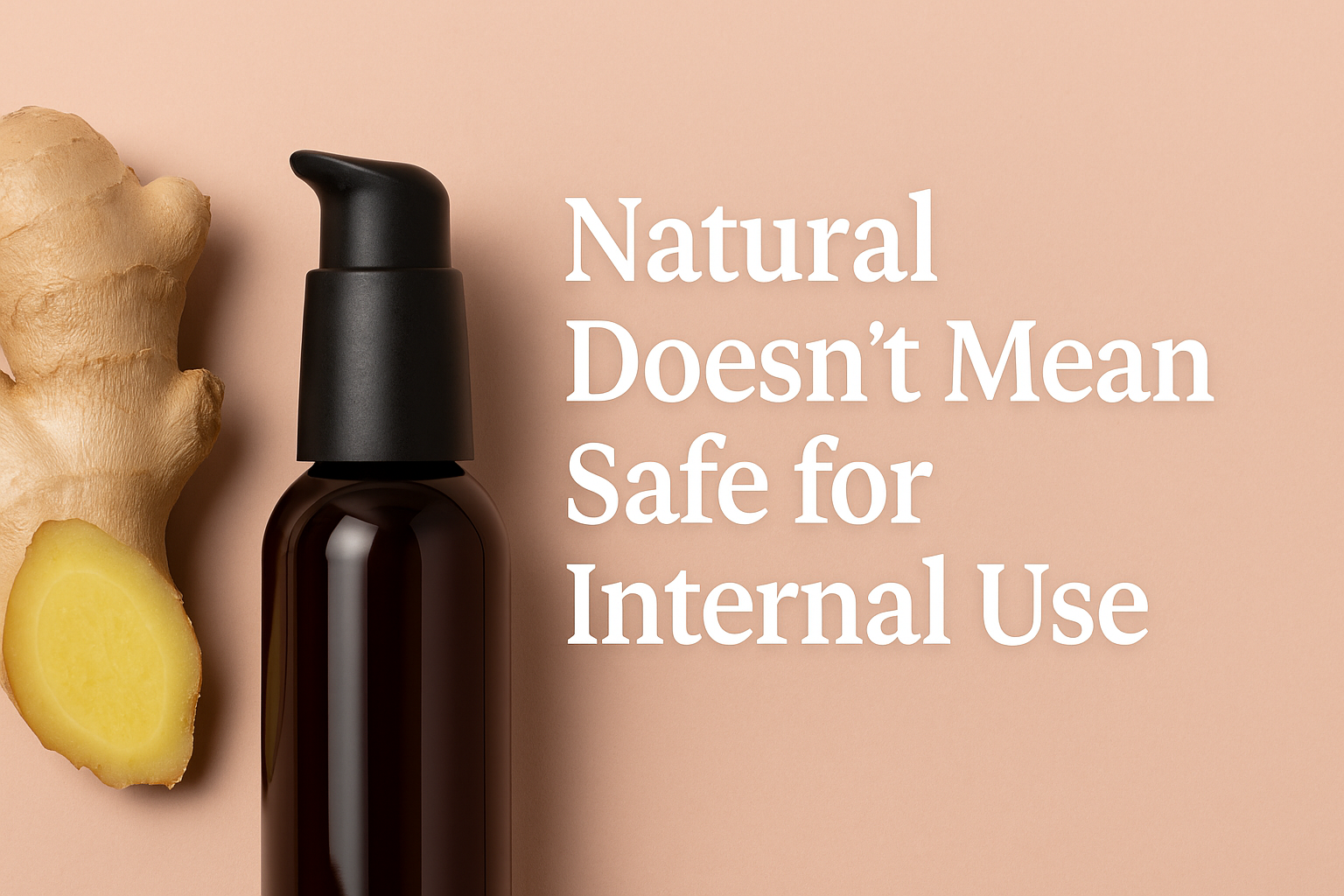
I recently came across a brand selling ginger-based sprays and oils marketed for intimate use here in Singapore. The packaging is sleek, the branding is bold, and the messaging screams “natural” and “food-grade safe.” They claim these products – inspired by figging, a BDSM practice – are suitable for anal, vaginal, and genital application, even during oral play.
Here’s what concerns me as a sexologist: these products aren’t tested for mucous membranes, yet they’re being marketed for internal use with minimal safety guidance – often just a quick chat at pop-up events.
Let me break down why this matters for your intimate health.
Your Intimate Areas Aren’t Just Skin
The tissue lining your vagina, anus, and genitals is mucous membrane – quite different from regular skin. It’s thinner, more absorbent, incredibly vascular, and maintains its own delicate bacterial balance (Farage & Maibach, 2006).
What might feel tingly or stimulating on your arm can actually cause harm internally – think irritation, micro-tears, disrupted pH levels, and increased infection risk.
Your vaginal epithelium, for example, works hard to maintain a pH of 3.8-4.5, with lactobacilli as the dominant flora keeping everything balanced (Ravel et al., 2011). When we introduce irritating substances, we can disrupt this carefully maintained ecosystem, potentially opening the door to bacterial vaginosis or other infections.
Your Body’s Protective Response Can Backfire
Here’s something fascinating about our bodies: when something burns or stings internally, your pelvic floor muscles reflexively tighten as a protective response (Rosenbaum, 2007).
It’s your body saying “hey, something’s not right here!” But this involuntary clenching can actually intensify pain, cause cramping, or even lead to persistent pelvic floor tension. I’ve worked with clients who’ve experienced ongoing discomfort from situations just like this, and recovery takes time.
“Natural” Doesn’t Automatically Mean “Safe for Internal Use”
I love natural ingredients as much as anyone. But here’s the thing: ginger contains gingerols and shogaols – compounds that create that characteristic burning sensation (Grzanna et al., 2005).
Yes, it’s completely natural. So is poison ivy, right?
While ginger has been studied extensively for oral consumption and some topical applications, there’s surprisingly limited research on its safety for vaginal or rectal mucosa. The capsaicin-like effect of gingerols can cause significant irritation to these delicate tissues (Bodeker & Kronenberg, 2002).
What Coconut Oil Actually Does (and Doesn’t Do)
The recommendation to use coconut oil if things get too intense? I need to address this gently but honestly – it’s not the safety solution it seems to be.
Here’s why:
- Coconut oil isn’t pH-balanced for vaginal health
- It can disrupt your natural lactobacillus flora – those good bacteria working hard to keep infections at bay
- This disruption actually increases your risk of bacterial vaginosis and yeast infections (Strandberg et al., 2010)
- It breaks down latex condoms, putting you at risk for STIs and unplanned pregnancy (Voeller et al., 1989)
I know coconut oil has this wonderful “natural remedy” reputation, but when it comes to vaginal health, the science tells us a different story.
What Singapore’s Regulations Actually Cover
I’ve heard claims that these products don’t need Health Sciences Authority (HSA) approval because they’re “natural.” But it’s actually more nuanced than that.
The HSA evaluates products based on how they’re marketed and what they’re intended to do (Health Sciences Authority, 2023):
- External cosmetics might not need pre-market approval
- But products marketed for internal application or with claims about affecting bodily functions can fall under therapeutic product or medical device regulations – which do require proper evaluation
Being “natural” doesn’t automatically exempt a product from regulatory oversight. And honestly? As consumers, we deserve that layer of protection for products we’re putting inside our bodies.
The Missing Evidence
I went looking for publicly available clinical safety studies, dermatological testing, or gynaecological approval for internal use of these products. I couldn’t find any.
For something being marketed for your most sensitive and intimate areas, that’s genuinely concerning.
Evidence-based intimate products go through rigorous testing for pH compatibility, mucous membrane irritation potential, and microbiome impact (Edwards & Panay, 2016). Without this data, we’re essentially experimenting on our own bodies – and that’s not a risk I’d want anyone to take unknowingly.
Sexual Exploration Deserves Better
Look, I’m genuinely all for exploring pleasure and trying new things in the bedroom. Sexual wellness should absolutely be fun, adventurous, and empowering. Curiosity about your body and pleasure is something I celebrate in my work every single day.
But here’s my heart on this: exploration should also be safe. You deserve both pleasure and protection.
Our intimate areas deserve:
- pH-balanced formulations designed specifically for mucous membranes
- Proper clinical testing and safety data
- Regulatory oversight that has our backs
- Evidence-based recommendations, not just clever marketing
And let’s be real – in Singapore’s humid climate, many of us already deal with yeast infections, bacterial imbalances, and heat-related intimate discomfort. Why add unnecessary risks to that mix?
Safe Alternatives for Sensation Play
If you’re curious about temperature play or sensation products (and I think curiosity about pleasure is wonderful!), there are actually safe, tested options:
- Proper intimate lubricants with warming effects, specifically formulated for internal use
- Body-safe temperature play tools designed for intimate areas
- Products that have undergone clinical testing for mucous membranes
The key difference? These products have been through proper safety testing and are designed with your intimate anatomy in mind.
The Bottom Line
I’m sharing this not to shame anyone or to be the “fun police” – truly. I’m sharing it because I care about you having all the information you need to make choices that honor both your pleasure and your wellbeing.
Your sexual health matters deeply. Your pleasure matters. But your safety should never be compromised by appealing branding and “natural” marketing buzzwords – no matter how pretty the packaging or how persuasive the pitch.
Sexual exploration is beautiful. Let’s just make sure we’re doing it safely.
Want to Explore Safely? Let’s Talk
If you have questions about intimate products, temperature play, or sexual wellness in general, we’re here to help. Book a consultation, or drop your questions below – no judgment, just evidence-based guidance and genuine care for your wellbeing.
Stay safe, stay curious, and never hesitate to ask questions. That’s genuinely what we’re here for.
References
Bodeker, G., & Kronenberg, F. (2002). A public health agenda for traditional, complementary, and alternative medicine. American Journal of Public Health, 92(10), 1582-1591.
Edwards, D., & Panay, N. (2016). Treating vulvovaginal atrophy/genitourinary syndrome of menopause: How important is vaginal lubricant and moisturizer composition? Climacteric, 19(2), 151-161.
Farage, M. A., & Maibach, H. I. (2006). The vulvar epithelium differs from the skin: Implications for cutaneous testing to address topical vulvar exposures. Contact Dermatitis, 55(1), 5-14.
Grzanna, R., Lindmark, L., & Frondoza, C. G. (2005). Ginger—an herbal medicinal product with broad anti-inflammatory actions. Journal of Medicinal Food, 8(2), 125-132.
Health Sciences Authority. (2023). Guidance on cosmetic products. Ministry of Health, Singapore.
Ravel, J., Gajer, P., Abdo, Z., Schneider, G. M., Koenig, S. S., McCulle, S. L., Karlebach, S., Gorle, R., Russell, J., Tacket, C. O., Brotman, R. M., Davis, C. C., Ault, K., Peralta, L., & Forney, L. J. (2011). Vaginal microbiome of reproductive-age women. Proceedings of the National Academy of Sciences, 108(Supplement 1), 4680-4687.
Rosenbaum, T. Y. (2007). Pelvic floor involvement in male and female sexual dysfunction and the role of pelvic floor rehabilitation in treatment: A literature review. The Journal of Sexual Medicine, 4(1), 4-13.
Strandberg, K. L., Peterson, M. L., Lin, Y. C., Pack, M. C., Chase, D. J., & Schlievert, P. M. (2010). Glycerol monolaurate inhibits Candida and Gardnerella vaginalis in vitro and in vivo but not Lactobacillus. Antimicrobial Agents and Chemotherapy, 54(2), 597-601.
Voeller, B., Coulson, A. H., Bernstein, G. S., & Nakamura, R. M. (1989). Mineral oil lubricants cause rapid deterioration of latex condoms. Contraception, 39(1), 95-102.
About Dr. Martha Tara Lee

Dr. Martha Tara Lee has been a passionate advocate for positive sexuality since 2007. With a Doctorate in Human Sexuality and a Master’s in Counseling, she founded Eros Coaching in 2009 to help individuals and couples lead self-actualized and pleasurable lives. Her expertise includes working with couples in unconsummated marriages, individuals with sexual inhibitions or desire discrepancies, men facing erection and ejaculation concerns, and members of the LGBTQIA+ and kink communities. She welcomes people of all sexual orientations and offers both online and in-person consultations in English and Mandarin.
Dr. Lee is the only certified sexuality educator by the American Association of Sexuality Educators, Counselors and Therapists (AASECT) in the region since 2011, and became an AASECT-certified sexuality educator supervisor in 2018. Her fun, educational, and sex-positive approach has been featured in international media including Huffington Post, Newsweek, and South China Morning Post. She currently serves as Resident Sexologist for the Singapore Cancer Society, Of Noah.sg, OfZoey.sg, and Sincere Healthcare Group, and is the host of the podcast Eros Matters.
An accomplished author, Dr. Lee has published four books: Love, Sex and Everything In-Between (2013), Orgasmic Yoga: Masturbation, Meditation and Everything In-Between (2015), From Princess to Queen: Heartbreaks, Heartgasms and Everything In-Between (2017), and {Un}Inhihibited (2019). Her contributions have been recognized with numerous honors, including Her World’s Top 50 Inspiring Women under 40 (2010), CozyCot’s Top 100 Inspiring Women (2011), Global Woman of Influence (2024), the Most Supportive Relationship Coach (Singapore Business Awards, APAC Insider, 2025), and the Icon of Change International Award (2025).
You can read the testimonials she’s received over years here. For her full profile, click here. Email her here.