 Become a Patron!
 This week, the FDA expanded approval for Addyi (flibanserin) to include postmenopausal women under 65. CEO Cindy Eckert called it “historic” in her interview with TIME. And she’s not wrong about the systemic inequities.
Dozens of sexual-health treatments exist for men; women have far fewer FDA-approved options for low desire. That inequity is real. But scarcity doesn’t automatically make a mediocre option worth celebrating—it makes the absence of better options unacceptable.
Let me show you what the latest research—and leading sexologists—are actually saying.
What the 2024 Science Says
A comprehensive meta-analysis published in June 2024 examined 8 randomized trials involving 7,906 women. For premenopausal women on the 100mg dose, flibanserin produced 0.69 additional satisfying sexual events per month—not even one full additional encounter. For postmenopausal women, the effect was even smaller: 0.37 additional events monthly.
The researchers’ conclusion? “While flibanserin has demonstrated efficacy… its therapeutic advantages may be overshadowed by the higher likelihood of adverse events.”
A 2022 analysis examined effect sizes—the statistical measure of treatment impact. Effects smaller than 0.20 are considered “less than small.” Addyi’s effects ranged between 0.20 and 0.28 across measures. The conclusion: “flibanserin’s efficacy is likely not clinically meaningful.”
What Leading Sexologists and Researchers Say
Dr. Leonore Tiefer (Clinical psychologist, NYU School of Medicine, founder of the New View Campaign) argues the pharmaceutical approach fundamentally misunderstands women’s sexuality. She characterizes the “female Viagra” framing as superficial and notes that the theoretical mechanism remains speculative—there’s no validated measure of the proposed dopamine-serotonin model. She contends that in a society where sexual performance anxiety runs high, biological explanations offer convenient excuses that bypass the actual contextual factors shaping desire.
Dr. Lori Brotto (Psychologist, UBC Sexual Health Laboratory, Canada Research Chair in Women’s Sexual Health) questions whether the marginal increase in sexual events justifies the significant side effects. She points out the inherent conflict: “There’s no profit motive in promoting therapy or mindfulness.”
Her research consistently shows structured mindfulness-based interventions produce significant improvements without side effects. Yet this evidence-based approach receives a fraction of the attention and funding of pharmaceutical solutions.
Dr. Rosemary Basson (Director, UBC Sexual Medicine Program) developed the responsive desire model that fundamentally challenges Addyi’s premise. Her research demonstrates that “many people actually feel desire only after they have started making love”—not the spontaneous, lightning-bolt desire the pharmaceutical model assumes. This contextual, responsive pattern characterizes many women’s sexuality. A medication targeting spontaneous desire misses the actual experience of a significant portion of women seeking help.
Carol Tavris (Social psychologist, writing in Skeptic magazine) characterized the approval process as driven by commercial interests rather than robust science. She noted that once the FDA set a low bar with flibanserin, subsequent drugs with even weaker efficacy gained approval without rigorous scrutiny—exactly as critics predicted.
Barbara Mintzes, Leonore Tiefer, and Lisa Cosgrove published a 2021 analysis in BMJ Sexual & Reproductive Health concluding that “a politicized industry-sponsored advocacy campaign and conflicted patient and expert testimony likely influenced flibanserin’s approval at its third attempt.” They found that in clinical trials, flibanserin led to an average of only one additional enjoyable sexual experience every two months, while its successor bremelanotide showed none.
The Side Effects Matter
The 2024 meta-analysis found that compared to women taking placebo, those on Addyi experienced:
- Four times higher risk of dizziness
- Four times higher risk of extreme sleepiness
- 2.4 times higher risk of nausea
- More than double the likelihood of discontinuing due to side effects
The alcohol restriction is severe: You cannot drink on this medication. If you have 1-2 drinks, wait at least 2 hours before your bedtime dose. Three or more drinks? Skip the dose entirely. The combination can cause dangerous blood pressure drops and fainting.
The irony? The alcohol safety study tested this on 23 men and only 2 women—for a drug designed exclusively for women. Dr. Brotto pointed out that gender differences in alcohol metabolism are well established, with women more susceptible to toxicity effects—making the interaction potentially more dangerous in the target population.
For many women, sharing wine over dinner is part of connection and relaxation. This drug demands you choose.
We Don’t Fully Understand How It Works
The FDA’s own label states: “The mechanism of action of ADDYI in the treatment of premenopausal women with hypoactive sexual desire disorder is not known.”
The theory involves modulating serotonin, dopamine, and norepinephrine. But we don’t fully understand how—and certainly not in a way that maps cleanly onto women’s lived sexual desire with all its contextual complexity, relationship dynamics, and responsive patterns.
Originally developed as an antidepressant, flibanserin failed efficacy trials for depression. The pivot was driven by secondary signal findings rather than a clear, theory-driven model of female desire.
The Menopause Context
About 40-55% of women going through menopause experience changes in sexual desire. For those with surgical menopause (hysterectomy with ovary removal), up to 26% meet criteria for HSDD (Leiblum et al., 2006).
This distress is genuine. Women describe feeling like they’ve lost part of themselves, missing connection with partners, grieving their former sexual selves. HSDD is associated with higher rates of depressive symptoms, along with significant decrements in quality of life and relationship satisfaction.
We absolutely need solutions. But needing a solution doesn’t make a mediocre solution suddenly adequate.
What Actually Helps: The Evidence
Dr. Brotto’s decades of research, including studies published through 2024, consistently shows structured mindfulness-based interventions produce meaningful change. These programs typically include mindfulness meditation, education about responsive desire, body awareness exercises, and discussion components delivered over several sessions.
No side effects. No alcohol restrictions. No $800-1,600 monthly cost. And importantly—they address how many women’s desire actually works, not how pharmaceutical companies wish it worked.
Her books Better Sex Through Mindfulness (2018) and The Better Sex Through Mindfulness Workbook (2022) compile decades of clinical trials into accessible resources.
Research also supports cognitive behavioral therapy, sensate focus exercises, addressing relationship dynamics and power imbalances, processing trauma, and creating sustainable life contexts that actually allow space for desire.
The Real Issue
The pharmaceutical industry has yet to develop treatments with population-level effectiveness that justifies their risks and restrictions. This failure stems from three core problems:
- Modest efficacy that doesn’t justify the cost: Population-level benefits don’t outweigh the side effects, alcohol restrictions, and expense
- Fundamental theoretical mismatch: The drug targets spontaneous desire, but many women’s desire actually functions responsively and contextually
- Misplaced priorities: Pharmaceutical solutions receive disproportionate funding over evidence-based psychological interventions that address the actual complexity of women’s sexuality
Some women do report meaningful benefit from Addyi, and their experiences are valid. The issue isn’t invalidating individual responses—it’s the population-level risk-benefit profile and the absence of better pharmaceutical options a decade after approval.
Who Might Still Reasonably Try Addyi?
If you’re considering it, this would be the profile for informed decision-making:
- You fully understand the modest evidence (approximately 0.5-0.7 additional events monthly)
- You can completely abstain from alcohol indefinitely
- You have no hypotension risk or cardiovascular concerns
- You’re not taking medications that interact with CYP3A4 inhibitors
- You’re willing to trial for 8-12 weeks then objectively reassess
- You’ve explored contextual factors (stress, relationship dynamics, medical causes)
- You understand this targets spontaneous desire, not responsive desire patterns
- You have realistic expectations and aren’t hoping for dramatic transformation
This isn’t about denying access—it’s about informed consent based on realistic expectations rather than pharmaceutical marketing.
What I Explore With Clients
When women consult me about low desire:
1) Rule out medical causes including thyroid dysfunction, hormonal changes (especially perimenopause/menopause), medications (particularly SSRIs and SNRIs that significantly suppress desire), chronic pain conditions, sleep disorders, untreated depression or anxiety, diabetes, cardiovascular disease, and other systemic conditions.
2) Examine context
- Do you have mental and emotional space for desire, or is your mind constantly occupied with responsibilities?
- Is domestic and emotional labor equitably distributed, or are you carrying the “mental load”?
- Do you experience safety and security in your relationship?
- Are you free from chronic stress or unprocessed trauma?
- Do you have body autonomy and freedom from pressure or coercion?
- Does your partner prioritize your pleasure and understand responsive desire?
- Do you receive cultural messaging that validates female sexuality rather than shaming it?
For many women, low desire isn’t dysfunction. It’s a completely rational response to unsustainable conditions.
3) Consider evidence-based interventions including mindfulness-based approaches, cognitive behavioral therapy, sensate focus, addressing relationship dynamics and communication patterns, exploring power imbalances and resentment, processing cultural and religious messaging about sexuality, building body trust and pleasure literacy, and creating sustainable life contexts that allow space for desire.
If You’re in Singapore
Addyi isn’t registered with the Health Sciences Authority. The HSA flagged flibanserin in overseas products in 2017 as a potent ingredient requiring medical supervision. Unregulated online products can be unsafe and should be avoided. If you’re considering pharmaceutical options for low desire, consult a healthcare provider about what’s legally available and appropriate for your situation.
Given the modest efficacy and significant restrictions documented in research, the regulatory gap may unintentionally spare women here from pursuing a medication with limited population-level benefit.
The Bottom Line
This isn’t anti-medicine. It’s anti-mediocrity disguised as progress. I’m not saying “don’t treat low desire.” I’m saying “treat it honestly, contextually, and with standards as high as those applied to men.”
We deserve pharmaceutical research that understands female sexuality. We deserve treatments as effective as those available for men. We deserve options that don’t force impossible choices.
Until we have those options, I’ll keep doing what the evidence shows actually works: comprehensive assessment, addressing actual sources of desire loss, evidence-based sexuality education and counseling grounded in how women’s desire actually functions.
My team at Eros Coaching offers individual counseling, couples work, and comprehensive sexuality education rooted in the latest research—not pharmaceutical promises. Book a consultation at ErosCoaching.com
Because you deserve better than being told to accept barely adequate.
References
Eckert, C. (2025, December 16). [Interview]. TIME. https://time.com/7204764/addyi-flibanserin-fda-approval-postmenopausal-women/
Kamrul-Hasan, A. B. M., et al. (2024). Role of flibanserin in managing hypoactive sexual desire disorder in women: A systematic review and meta-analysis. Medicine, 103(25), e38592. https://doi.org/10.1097/MD.0000000000038592
Brotto, L. A., et al. (2024). Impact of mindfulness versus supportive sex education on stress in women with sexual interest/arousal disorder. Journal of Behavioral Medicine, 47(4), 721-733. https://doi.org/10.1007/s10865-024-00491-5
Mintzes, B., Tiefer, L., & Cosgrove, L. (2021). Bremelanotide and flibanserin for low sexual desire in women: The fallacy of regulatory precedent. BMJ Sexual & Reproductive Health, 48(3), 159-164. https://doi.org/10.1136/bmjsrh-2021-201146
Spielmans, G. I. (2022). Pooled analysis confirms flibanserin’s unimpressive efficacy, raises measurement questions. Sexual Medicine, 10(6), 100579. https://doi.org/10.1016/j.esxm.2022.100579
Simon, J. A., et al. (2022). Clinically meaningful benefit in women with hypoactive sexual desire disorder treated with flibanserin. Sexual Medicine, 10(1), 100476. https://doi.org/10.1016/j.esxm.2021.100476
Leiblum, S. R., et al. (2006). Hypoactive sexual desire disorder in postmenopausal women: US results from the Women’s International Study of Health and Sexuality (WISHeS). Menopause, 13(1), 46-56.
Brotto, L. A. (2018). Better sex through mindfulness: How women can cultivate desire. Greystone Books.
Tavris, C. (2022, August 16). Big Pharma’s cynical search for a female sex drug. Skeptic. https://www.skeptic.com/reading_room/big-pharmas-cynical-search-for-female-sex-drug/
U.S. FDA. (2019). ADDYI prescribing information. https://www.accessdata.fda.gov/drugsatfda_docs/label/2019/022526s009lbl.pdf
Women’s Brain Health Initiative. (2021, September 9). Addyi’s alcohol safety was tested mostly on men. https://womensbrainhealth.org/think-tank/think-twice/addyis-alcohol-safety-was-tested-mostly-on-men
About Dr. Martha Tara Lee

Dr. Martha Tara Lee has been a passionate advocate for positive sexuality since 2007. With a Doctorate in Human Sexuality and a Master’s in Counseling, she founded Eros Coaching in 2009 to help individuals and couples lead self-actualized and pleasurable lives. Her expertise includes working with couples in unconsummated marriages, individuals with sexual inhibitions or desire discrepancies, men facing erection and ejaculation concerns, and members of the LGBTQIA+ and kink communities. She welcomes people of all sexual orientations and offers both online and in-person consultations in English and Mandarin.
Dr. Lee is the only certified sexuality educator by the American Association of Sexuality Educators, Counselors and Therapists (AASECT) in the region since 2011, and became an AASECT-certified sexuality educator supervisor in 2018. Her fun, educational, and sex-positive approach has been featured in international media including Huffington Post, Newsweek, and South China Morning Post. She currently serves as Resident Sexologist for the Singapore Cancer Society, Of Noah.sg, OfZoey.sg, and Sincere Healthcare Group., and is the host of the podcast Eros Matters.
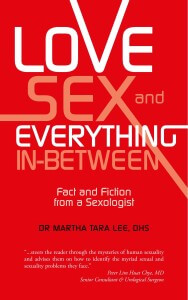
An accomplished author, Dr. Lee has published four books: Love, Sex and Everything In-Between (2013), Orgasmic Yoga: Masturbation, Meditation and Everything In-Between (2015), From Princess to Queen: Heartbreaks, Heartgasms and Everything In-Between (2017), and {Un}Inhihibited (2019). Her contributions have been recognized with numerous honors, including Her World’s Top 50 Inspiring Women under 40 (2010), CozyCot’s Top 100 Inspiring Women (2011), Global Woman of Influence (2024), the Most Supportive Relationship Coach (Singapore Business Awards, APAC Insider, 2025), and the Icon of Change International Award (2025).
You can read the testimonials she’s received over years here. For her full profile, click here. Email her here.