
 Become a Patron!
Date/Time
Date(s) - 25/07/2026
1:00 pm - 3:00 pm
Categories
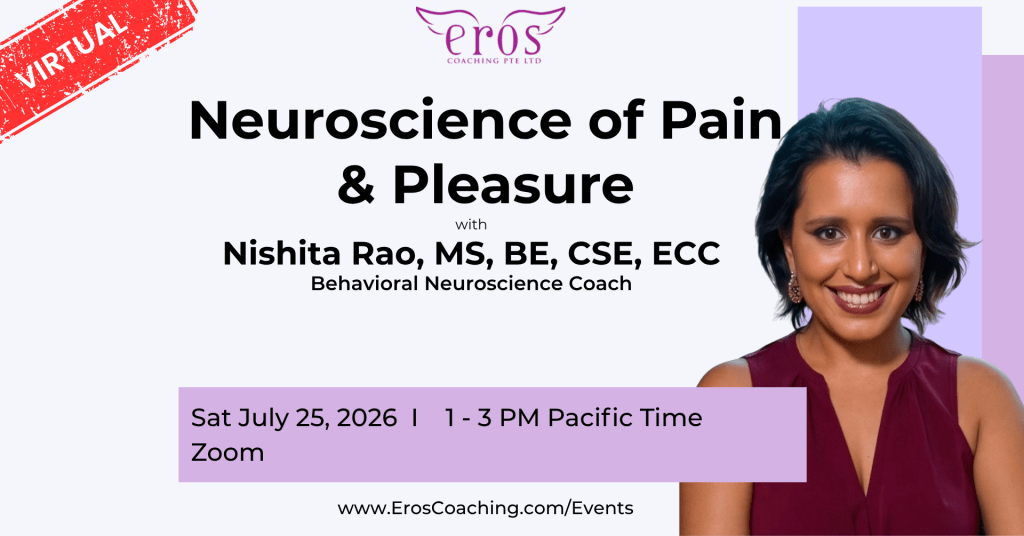
BDSM offers a unique lens through which to examine the neuroscience of pain and pleasure. While pain is traditionally seen as a negative stimulus and pleasure as a positive one, BDSM disrupts this binary, showing how pain can be pleasurable and how power dynamics influence neurochemical responses. This class will explore the neurobiological, psychological, and evolutionary underpinnings of BDSM experiences, examining how pain interacts with the brain’s reward, pleasure, and stress systems.
The neuroscientific investigation of pain has undergone substantial revision in recent decades. Newer models emphasize pain not as a direct readout of peripheral nociceptive input, but as an inference constructed by the brain through perceptual awareness of sensory inputs, expectations and contextual information. This constructivist view of pain perception provides a theoretical foundation for understanding how identical nociceptive stimuli can produce radically different subjective experiences depending on the context in which they occur.
Learning Objectives:
- At the end of the session, attendees will be able to explain the neural mechanisms of pain and pleasure
- At the end of the session, attendees will be able to critically evaluate role of reward prediction error and pain prediction error in reinforcement learning.
Satisfies Core Knowledge Areas:
B. Developmental sexuality from a bio-psycho-social perspective across the life course.,
C. Socio-cultural, familial factors (e.g., ethnicity, culture, religion, spirituality, socioeconomic status, family values), in relation to sexual values and behaviors.,
F. Diversities in sexual expression and lifestyles, including, but not limited to, polyamory, swinging, BDSM.
Date: Sat July 25, 2026
Time: 1 – 3 PM Pacific Time (US and Canada) 2 Hrs
Platform: Online Synchronous (Zoom)
Fee:
US$80 Accessibility Rate
US$100 Normal Rate

US$80 Accessibility Rate
US$100 Normal Rate
Do check out our media policy.
 About Nishita Rao
Nishita Rao is the first Indian to be certified by AASECT as a Sexuality Educator. She is also a Certified Holistic Sexuality Educator from ISEE with a background in Neuroendocrinology (MS Neuroscience) and Genetics (BE Biotechnology).
Nishita is also a Behavioral Neuroscience Coach and a Reiki Grandmaster who integrates Eastern and Western modalities into her practice. She approaches healing through Attachment-Based Therapy, Emotionally Focused Therapy, Mindfulness-Based Cognitive Therapy (MBCT), Trauma-Focused Interventions, Eastern Therapeutic Modalities, Integrative Therapy, and Person-Centered Therapy.
Her diverse methodologies include Mandala Art Therapy, Raga Therapy (inspired by 12th-century Indian music), Bibliotherapy, Mindfulness, Pranayama (Breathwork), Aromatherapy, Usui (Jikidem) Reiki, Karuna Reiki, and Seichem Reiki, Chakra Balancing, Body Mapping, Tea Blending Therapy, and more.
Nishita’s areas of expertise encompass Sexual Abuse Recovery, Stress Management, Indigenous Healing Practices, Decolonial Therapy, Generational and Intergenerational Trauma Therapy, and Land-Based Therapy. Her work is BIPOC-affirming and LGBTQQIA2SP+-affirming, ensuring an inclusive and culturally sensitive healing environment.
Nishita is also an Interdisciplinary scientist— her current research delves into post-colonial imprints on human social and sexual attitudes. She is a Dance Ethnographer with a research focus on Belly dance, Sadir, Bharatanatyam, Mohiniyatam, Kathak and Kathakalli. She is also an Ethnomusicologist and a Philologist, tracking the linguistic pedagogy embedded in the lyrical structures of Carnatic renditions.