
 Become a Patron!
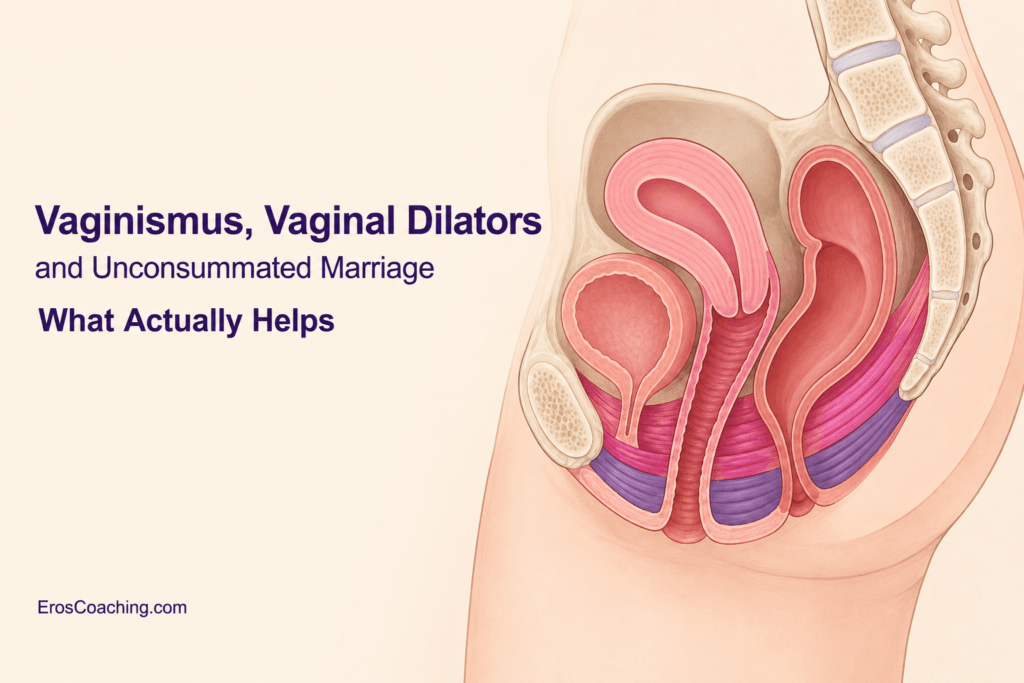 When penetration has never happened
An unconsummated marriage is often described as though the couple has failed to complete a simple task.
That framing creates shame, secrecy and pressure. It also overlooks what may actually be happening.
Penetration may be painful, frightening or impossible. One partner may experience erection or ejaculation difficulties. One or both partners may have limited sexual knowledge, low desire, fear of pregnancy, religious shame or past experiences that affect their sense of safety. Sometimes several factors overlap.
Vaginismus can affect people with vaginas across sexual orientations and relationship structures. Not everyone wants penile-vaginal intercourse, and treatment should not assume that intercourse is the goal.
Vaginismus is one possible reason penetration has not happened.
Vaginismus involves an involuntary tightening or guarding response around the vaginal opening when penetration is anticipated or attempted. A person may want penetration and still find that their body pulls away, tightens or experiences pain.
This may happen during attempted intercourse, finger insertion, tampon use, a medical examination or the use of a vaginal dilator.
It is not stubbornness, lack of love or a conscious refusal.
Why pressure makes it worse
Many couples begin with patience. As months or years pass, however, penetration can become loaded with meaning.
It may be treated as proof of love, attraction, adulthood, fertility or whether the marriage is “real”. Each attempt then becomes a test.
The person anticipating pain may tense before anything happens. Their partner may become anxious about hurting them, losing an erection or being rejected. Both people start monitoring the body instead of experiencing pleasure and connection.
When an attempt stops, one person may feel frightened or ashamed while the other feels disappointed or helpless. Neither person may intend harm, but the pressure grows.
Repeating the same painful or frightening attempt is not useful practice. It can teach the body to expect further distress.
Pushing harder, using more force or telling someone to “just relax” does not resolve vaginismus. It can intensify fear, guarding and avoidance.
It may not be only vaginismus
Painful or difficult penetration deserves appropriate assessment before anyone assumes that vaginal dilators are the complete answer.
Possible contributors include:
- Vulval or vaginal infections
- Skin conditions
- Hormonal changes and vaginal dryness
- Pelvic-floor overactivity
- Pain around the vaginal entrance
- Endometriosis or other causes of deeper pelvic pain
- Previous injuries, surgery or medical procedures
- Fear, trauma or a lack of emotional or sexual safety
The location and type of pain matter. Burning or tearing around the vaginal entrance is different from pain felt deeper in the pelvis. Pain, pressure, involuntary guarding and fear of penetration may require different forms of assessment and support.
A normal gynaecological examination also does not mean that the difficulty is imaginary. The body may be medically healthy while the muscles and nervous system have learnt to anticipate penetration as painful or threatening.
I do not assume that every person with painful penetration has vaginismus. When symptoms suggest a medical or pelvic-health concern, I recommend assessment by an appropriate doctor or pelvic-floor physiotherapist.
What are vaginal dilators?
Vaginal dilators—also called vaginal trainers—are smooth devices that usually come in graduated sizes.
A person may begin with a size that feels manageable and progress gradually when their body is ready. The purpose is not to stretch the vagina aggressively or force it to tolerate pain.
Dilator work may help someone:
- Become more familiar with their anatomy
- Approach the vaginal opening without rushing
- Notice involuntary tension or guarding
- Learn to recognise pelvic-floor tension and practise softening it, sometimes with professional guidance
- Experience insertion while retaining control over pace, depth and movement
- Build confidence before progressing to a finger, medical examination, sex toy or penis, if that is their goal
Vaginal dilators are a tool. They are not a test of willpower, a punishment or proof that someone is trying hard enough.
Should vaginal dilators hurt?
Vaginal dilator practice should not involve forcing through sharp, burning or escalating pain.
Some people may notice unfamiliar pressure, mild discomfort or anxiety when they begin. That is different from treating significant pain as something they must endure.
The person using the dilator should remain in control. They decide whether to begin, how far to proceed and when to stop. Progress does not require moving to a larger size during every session.
Using more lubricant, changing position, reducing the depth, returning to a smaller size or stopping may be appropriate.
If dilator use repeatedly causes pain, bleeding, panic or increased guarding, pause and seek professional assessment.
Why buying vaginal dilators may not be enough
You may buy a set of vaginal dilators with every intention of using them, open the box, feel overwhelmed and put it away.
That does not mean you are unmotivated. It may mean the instructions have not addressed the fear, pain or pressure already attached to penetration.
You may not know which size to use, how often to practise, what sensations are acceptable or what to do when your body tightens. Dilator practice can then become another performance task: something you believe you must complete before you are allowed to feel normal, have intercourse or move forward with your relationship.
Effective support is not only about inserting progressively larger objects. It may also involve:
- Understanding what happens in your body before and during attempted penetration
- Learning about arousal, lubrication and pelvic-floor responses
- Addressing fear, shame, misinformation or traumatic associations
- Managing anxiety without dismissing pain
- Expanding intimacy and pleasure beyond penetration
- Improving communication between partners
- Coordinating care with a doctor or pelvic-floor physiotherapist
Vaginal dilators can support progress, but they should not become the only measure of progress.
For people who want a structured self-guided introduction, Sex Possible is my 28-day online educational programme on understanding and working with vaginismus. It does not replace individual medical assessment, pelvic-floor physiotherapy or counselling when these are needed.
You can also read an individual’s experience of using the programme in this Sex Possible testimonial. It is one person’s experience, not a promise that everyone will have the same outcome.
Arousal, pleasure and choice matter too
Dilator practice is sometimes presented as a purely mechanical exercise. That can make it feel clinical, compulsory or disconnected from sexuality.
For some people, practising in a calm and private setting, with enough time and no expectation of intercourse afterwards, makes the process more manageable. Lubricant, comfortable positioning, breathing and pelvic-floor awareness may help.
Others find that pleasant touch or arousal makes insertion easier. This should be optional, not prescribed as another task to perform correctly.
The aim is not merely to tolerate something being placed inside the vagina. It is to develop more choice, confidence and bodily awareness.
Penetration is also not the only valid form of sex. Couples can maintain affection, intimacy and sexual pleasure while penetration is temporarily or permanently off the agenda.
The partner’s role
A supportive partner does not take over the dilator process or repeatedly ask when intercourse will become possible.
They can help by respecting the person’s pace, accepting a stop without sulking, and participating in conversations about pleasure and intimacy that are not centred only on penetration.
It may be useful to discuss:
- How attempts at penetration begin
- What each person fears
- How disappointment is expressed
- Whether affection has become conditional on progress
- Whether every intimate moment is expected to lead to intercourse
- How the couple can remain connected without creating pressure
A partner can be caring and still feel disappointed. They cannot use that disappointment to override consent.
Consent remains necessary within marriage. The person experiencing vaginismus also does not have to manage their partner’s feelings by enduring pain.
What professional support may involve
Support for vaginismus may include psychosexual counselling, sexuality education, pelvic-floor physiotherapy, medical care and carefully paced home practice.
The first step is not automatically a vaginal dilator.
Assessment may include the person’s experience of pain, sexual and relationship history, previous attempts at penetration, medical factors, beliefs about sex, trauma, consent, safety, fertility pressure and what they actually want.
Not everyone has the same goal. One person may want comfortable intercourse. Another may want to use tampons, attend a medical examination or feel less frightened by their own body.
Support should be guided by the person’s goals—not by the assumption that everyone must achieve penile-vaginal intercourse.
I founded Eros Coaching in 2009 and have extensive experience working with individuals and couples experiencing vaginismus, penetration difficulties and unconsummated relationships. You can read more about my professional background and qualifications.
My structured three-month vaginismus programme may include assessment, sexuality education, individual or couple sessions, gradual home practice and coordination with suitable medical or pelvic-health professionals.
Sessions do not involve nudity, sexual touch or sexual activity with the practitioner.
Enquire about working with Dr Martha or a member of the Eros Coaching team.
A more useful first conversation
Instead of asking, “Why can’t we just do it?”, try:
- “What happens in your body when we think about penetration?”
- “What would help you feel more choice and less pressure?”
- “How can we remain close without turning tonight into another test?”
- “Would it help to pause intercourse attempts while we seek proper support?”
- “Which concerns should we discuss with a doctor, pelvic-floor physiotherapist or sexuality professional?”
These questions do not resolve vaginismus immediately. They create a safer starting point than blame, pressure or repeated painful attempts.
Frequently asked questions
1) Can vaginal dilators cure vaginismus?
Vaginal dilators can be useful within a broader treatment plan, but they are not a guaranteed cure or the complete treatment for everyone.
Some people may also need medical assessment, pelvic-floor physiotherapy, psychosexual counselling, sexuality education or couple work.
2) Can I use vaginal dilators without a therapist?
Some people can use dilators independently.
Professional guidance may be useful if you are unsure why penetration is painful, do not know how to begin, repeatedly experience significant pain or panic, or find that the dilators have become another source of pressure.
3) How quickly should I move to the next dilator size?
There is no universal schedule.
Moving up quickly is not evidence of better progress. Consider progressing when the current size feels sufficiently manageable and you remain in control. Returning to a smaller dilator is not failure.
4) Does my partner need to be involved?
Not necessarily. Dilator practice belongs to the person using them.
Couple sessions may be helpful when partner pressure, communication, avoidance, sexual expectations or relationship distress are affecting the situation.
5) Is vaginismus treatable?
Many people experience meaningful improvement with appropriate, individualised support. The process and outcome vary according to the person’s symptoms, contributing factors, goals and access to suitable care.
When to seek support
Seek professional support when penetration remains painful, frightening or impossible; attempts repeatedly end in distress; medical examinations are difficult; fertility plans are affected; vaginal dilators feel impossible to begin or continue; or resentment and avoidance are growing.
You do not need to wait until the relationship is in crisis.
Enquire about working with Dr Martha or a member of the Eros Coaching team.
Sources
- NHS: Vaginismus
- American College of Obstetricians and Gynecologists: When Sex Is Painful
- Leeds Teaching Hospitals NHS Trust: Vaginal Dilators
This article provides general sexuality education and does not replace individual medical or psychological advice.