
 Become a Patron!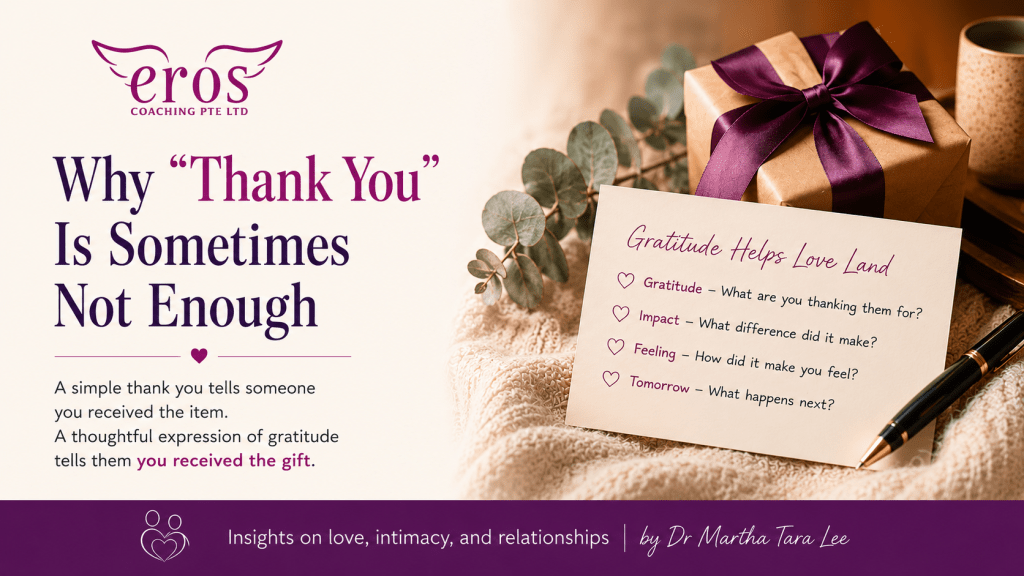
A simple thank you tells someone you received the item. A thoughtful expression of gratitude tells them you received the gift.
As a relationship counsellor and clinical sexologist, I spend a lot of time talking about communication, intimacy, conflict, desire, and relationships. Yet one of the most common complaints I hear has nothing to do with sex. It is the quiet resentment that builds when people feel unseen, unappreciated, or taken for granted.
I’ve lost count of the number of times I’ve heard some version of, “After everything I’ve done…” The details vary. Sometimes it comes from a husband who feels his efforts to provide for his family go unnoticed. Sometimes it comes from a wife carrying the invisible mental load of remembering birthdays, scheduling appointments, organising family logistics, and keeping daily life running smoothly. Sometimes it comes from an adult child caring for ageing parents or a friend who is always the one reaching out first.
Different circumstances. Same hurt.
What these people are usually asking for is not applause. They are not demanding recognition, keeping score, or seeking constant praise. They simply want to know that what they do matters. They want to know that their effort was seen, that it made a difference, and that it wasn’t taken for granted.
Over the years, I have come to believe that many relationship struggles are not caused by a lack of love. More often than not, they arise because appreciation is felt but never fully expressed.
Love Given Is Not Always Love Received
One reason this happens is that people express love differently.
Many readers will be familiar with Gary Chapman’s concept of the Five Love Languages: Words of Affirmation, Acts of Service, Receiving Gifts, Quality Time, and Physical Touch. Whether or not you agree with every aspect of the model, it highlights an important reality. People often express love in one way while the people they care about are looking for it in another.
A husband may work long hours because providing for his family is how he demonstrates love. His wife may long for quality time and meaningful conversation. A partner may spend hours searching for the perfect birthday gift because they want the recipient to feel cherished, while the recipient would much rather hear words of affection. Another person may quietly take care of countless practical tasks behind the scenes, assuming their effort speaks for itself.
Nobody is necessarily wrong. The love is there. It simply isn’t always recognised for what it is.
In other words, love given is not always love received.
This is where gratitude becomes so important. Most people think of gratitude as good manners. I think it serves a much more significant purpose. Gratitude helps people know that their love arrived. It reassures them that what they did mattered and that their effort reached the person it was intended for.
Interestingly, gratitude itself is a form of Words of Affirmation. Even if someone’s primary love language is Acts of Service, Gifts, Quality Time, or Physical Touch, hearing that their effort was noticed and valued can be deeply meaningful. In that sense, gratitude becomes a way of translating one love language into another.
We Spend a Lot of Time Teaching People How to Give
What strikes me is that we spend a great deal of time teaching people how to give, but very little time teaching them how to receive.
We encourage generosity, kindness, sacrifice, and thoughtfulness. We teach children to share. We praise people for helping others. We celebrate giving.
What we rarely discuss is the skill of receiving.
Receiving well is not passive. It is not merely accepting a compliment, a gift, a favour, or an act of kindness. Receiving well means helping the giver understand that their effort mattered. It means allowing them to experience the satisfaction of knowing that they made a difference. It means completing the emotional loop between giving and receiving.
A simple thank you acknowledges the transaction.
A thoughtful expression of gratitude deepens the connection.
The GIFT of Gratitude
When I started paying attention to the expressions of gratitude that stayed with me over the years, I noticed they had something in common. They did not simply acknowledge what was given. They explained why it mattered, described the difference it made, and often revealed something about the recipient’s experience.
Looking more closely, I realised these expressions of gratitude tended to contain four elements. Together, they form what I think of as a GIFT:
- Gratitude – What are you thanking the person for?
- Impact – What difference did it make?
- Feeling – How did it make you feel?
- Tomorrow – What happens next?
The framework is simple, but it transforms gratitude from a polite response into meaningful feedback.
A Bag Is Never Just a Bag
Imagine someone gives you a new work bag.
Most people would respond with something like, “Thank you for the bag.”
There is absolutely nothing wrong with that response. It is polite, appropriate, and appreciative. However, it tells the giver very little beyond the fact that you received the item.
Now consider this response:
Thank you for the bag. I love that you noticed I was always carrying multiple bags whenever I travelled. The compartments and pockets mean I can finally keep everything organised in one place, and it fits my laptop perfectly. It’s going to make travelling for work much easier. More than that, it makes me feel understood because you paid attention to something that has been frustrating me for a long time. I’m taking it with me on my next trip and I know I’ll be using it often.
Notice what changed.
The response no longer focuses only on the bag itself. It acknowledges the thought behind the gift. It highlights the bag’s features, explains the practical benefits, shares the emotional impact, and describes what happens next. More importantly, it lets the giver know that their observation, effort, and intention were understood.
What I find particularly interesting is that the second response is not really about the bag at all.
It is about feeling seen.
The bag simply became evidence that somebody was paying attention.
The Joy of Giving Depends on the Joy of Receiving
We often talk about the joy of receiving, but we spend far less time discussing the joy of giving. Yet anyone who has carefully chosen a gift knows that the real hope is not simply that the recipient likes the item. We hope they understand why we chose it, that it solves a problem, makes their life easier, brings them happiness, or helps them feel loved.
When someone takes the time to explain how our gift helped them, how it made them feel, and how they intend to use it, we get to experience the satisfaction of knowing that our effort mattered. That is one of the greatest pleasures of giving.
A simple thank you tells me you received the bag.
A thoughtful expression of gratitude tells me you received the gift.
The Same Principle Applies in Relationships
The same dynamic plays out in relationships every day.
A partner might say, “Thanks for working so hard.”
That is kind and appreciative.
However, compare it with:
Thank you for working so hard for our family. Because of you, I worry less about our finances and feel more secure about our future. I know the hours can be long, and I don’t always say it enough, but I appreciate what you’re doing for us. I’d love for us to make time for a date night this month so we can enjoy the life we’re working so hard to build together.
The difference is subtle but important. The first response acknowledges effort. The second explains why the effort matters. One receives the action. The other receives the love behind the action.
This is why gratitude can be such a powerful relationship skill. It helps people understand not only that they were successful in completing a task, but that they were successful in expressing care.
Helping Love Land
In many relationships, the problem is not a lack of love. In fact, there may be a great deal of love present. What is often missing is evidence that the love has been recognised, understood, and received.
A thoughtful expression of gratitude provides that evidence. It reassures the other person that their effort was seen, helps them understand the difference they made, and allows them to experience the emotional impact of their contribution.
Perhaps that is the real purpose of gratitude. Not merely to acknowledge what was given, but to let the giver know that their effort reached us.
A simple thank you tells someone you received the item.
A thoughtful expression of gratitude tells them you received the gift.
And in relationships, helping people know that their love has been received may be one of the greatest gifts we can offer in return.
Over the years, I have learned that many couples are not struggling because they do not love each other. They are struggling because they have difficulty expressing, recognising, and receiving that love. Learning how to communicate appreciation is only one small piece of that puzzle, but it can be a surprisingly powerful one.
If this sounds familiar, my team and I at Eros Coaching support individuals and couples who want to communicate more effectively, deepen emotional connection, and build healthier intimate relationships. Sometimes the difference between feeling loved and feeling lonely is not the amount of love available, but whether it is being recognised, expressed, and received.
About Dr. Martha Tara Lee

Dr. Martha Tara Lee has been a passionate advocate for positive sexuality since 2007. With a Doctorate in Human Sexuality and a Master’s in Counseling, she founded Eros Coaching in 2009 to help individuals and couples lead self-actualized and pleasurable lives. Her expertise includes working with couples in unconsummated marriages, individuals with sexual inhibitions or desire discrepancies, men facing erection and ejaculation concerns, and members of the LGBTQIA+ and kink communities. She welcomes people of all sexual orientations and offers both online and in-person consultations in English and Mandarin.
Dr. Lee is the only certified sexuality educator by the American Association of Sexuality Educators, Counselors and Therapists (AASECT) in the region since 2011, and became an AASECT-certified sexuality educator supervisor in 2018. Her fun, educational, and sex-positive approach has been featured in international media including Huffington Post, Newsweek, and South China Morning Post. She currently serves as Resident Sexologist for the Singapore Cancer Society, Of Noah.sg, OfZoey.sg, and Sincere Healthcare Group, and is the host of the podcast Eros Matters.
An accomplished author, Dr. Lee has published four books: Love, Sex and Everything In-Between (2013), Orgasmic Yoga: Masturbation, Meditation and Everything In-Between (2015), From Princess to Queen: Heartbreaks, Heartgasms and Everything In-Between (2017), and {Un}Inhibited (2019). Her contributions have been recognized with numerous honors, including Her World’s Top 50 Inspiring Women under 40 (2010), CozyCot’s Top 100 Inspiring Women (2011), Global Woman of Influence (2024), the Most Supportive Relationship Coach (Singapore Business Awards, APAC Insider, 2025), and the Icon of Change International Award (2025).
You can read the testimonials she’s received over years here. For her full profile, click here. Email her here.